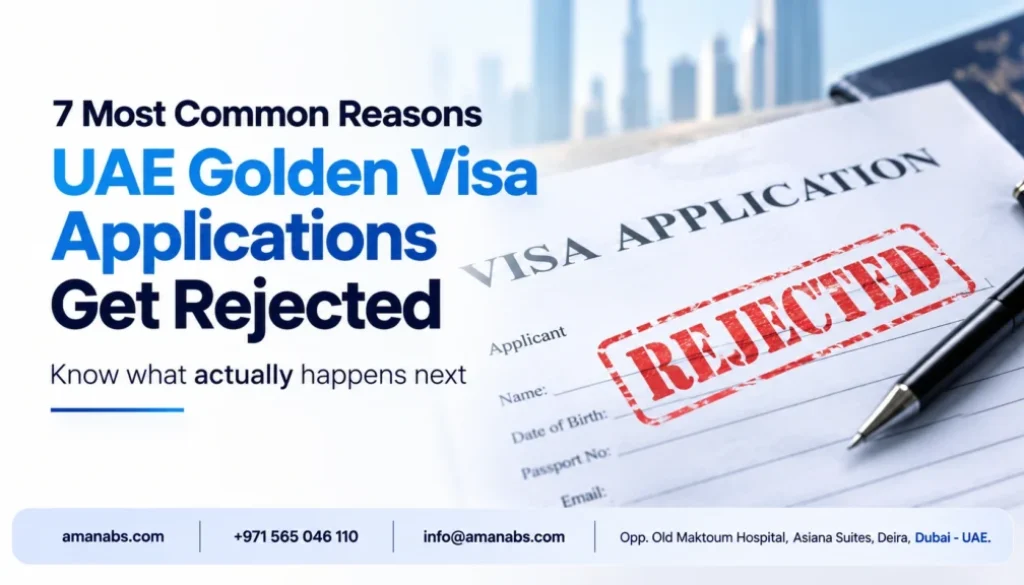
7 Most Common Reasons UAE Golden Visa Applications Get Rejected
For global executives, high-net-worth investors, and elite talent, securing a ten-year residency in the United Arab Emirates represents the ultimate milestone for professional and personal stability. Yet, even highly qualified individuals face unexpected golden visa rejections due to minor administrative oversights.
The federal digital immigration networks process thousands of applicants monthly, leaving zero tolerance for mismatched files or technical document errors. By understanding the mechanics behind these application stalls, you can systematically prepare your file to pass both automated AI checks and manual committee reviews with total confidence.
1.Mismatched Job Titles and Salary Certificates
The Ministry of Human Resources and Emiratization (MOHRE) and the Federal Authority for Identity, Citizenship, Customs and Port Security (ICP) maintain strict job classification systems. Aligning your employment contract with these official roles is mandatory.
To qualify under the skilled professional pathway, applicants must hold a position classified under MOHRE Skill Level 1 or 2 (Managers, Executives, or Specialized Professionals) and meet the AED 30,000 monthly basic salary threshold (excluding allowances).
A common pitfall is assuming a high total package offsets an administrative title. If your internal corporate contract lists you as a “Specialist” but your official visa designation reads “Administrative Staff,” automated cross-checks will flag the discrepancy and issue a rejection.
Key Rule: Every supporting document, salary certificates, labor contracts, and academic records, must reflect a single, consistent professional identity across all government systems.
2.Property Valuation and Financial Proof Errors
A senior executive and his business partner jointly purchased a luxury villa in Dubai valued at AED 3.6 million (split 50/50). Assuming the overall property value was enough to cover both of them, the executive applied for a Golden Visa. The application was rejected within 48 hours. Because they were not legally married, each partner’s share was evaluated at AED 1.8 million, falling just short of the individual AED 2 million floor. Had they structured the title deed differently or pooled spousal assets, the outcome would have been seamless.
Real estate remains one of the most direct paths to long-term residency. However, failure to structure ownership proof correctly frequently derail files.
While recent regulatory updates allow mortgaged and off-plan properties to qualify toward the AED 2 million threshold, joint ownership requires strict precision:
-
Spousal Ownership:
A couple can pool joint real estate assets to reach the AED 2 million mark, provided they submit a legally attested marriage certificate.
-
Non-Spousal Joint Ownership:
For business partners or non-married co-owners, each applicant’s individual share must independently clear the AED 2 million valuation.
3.Missing Academic Equivalency Certificates
For skilled professionals and outstanding graduates, academic credentials are a core evaluation metric. Submitting a university degree without full government attestation guarantees delays or outright rejection.
If your degree was earned outside the UAE, it must complete a multi-step legalization process:
- Notarization and Foreign Ministry attestation in the home country.
- UAE Embassy endorsement in the country of origin.
- Final attestation by the UAE Ministry of Foreign Affairs (MoFA).
- Equalization certificate issued by the UAE Ministry of Education (MoE).
Skipping the MoE equivalency step remains one of the single most frequent causes of rejection for corporate executives.
4.Technical Scan Inconsistencies
Immigration portals use Optical Character Recognition (OCR) systems to read, extract, and index applicant data. Low-quality document uploads are a surprisingly frequent administrative trigger for automatic rejections.
If passport scans or certificates contain glare, blurred lettering, or cropped borders, the OCR software flags the submission as incomplete. The system treats unreadable text the same as a missing document.
5.Unresolved Prior Immigration Files
The federal immigration database cannot process a 10-year residency file if there is an active conflict on your file.
If you previously held a company residence visa, partner visa, or tourist entry permit that was never formally closed out, your new application will trigger a portal lock. You must work with your previous employer or a PRO service to clear legacy records before initiating a long-term visa application.
6.Unattested Family Certificates for Dependents
While Golden Visas offer generous sponsorship options for spouses, children, and parents, dependent files must meet the exact same documentation standards as the primary applicant.
Attempting to submit foreign marriage or birth certificates without MoFA attestation and certified Arabic translations leads directly to family-level rejections. Every relationship document must be fully legalized prior to submitting dependent files.
7.Outdated Financial Audits (Entrepreneur Track)
Founders and startup leaders applying under the entrepreneur pathway must prove sustained commercial viability.
Submitting uncertified financial statements, internal balance sheets, or audit reports that are over a year old will cause immediate rejection. Applications require an official valuation report or financial statement certified by an accredited UAE auditor confirming the project value or revenue requirements set by the Ministry of Economy.
An administrative error or a single missing attestation can derail your residency timeline. The team at Amana Business Services, best business setup and PRO consultancy in Dubai, provides pre-submission audits, document attestation, MoE equivalency management, and direct PRO coordination with the ICP, GDRFA, and Land Departments.
Schedule a Consultation with Amana Business Services Today
About The Author