Business Bank Account Rejected in UAE? 4 Red Flags and How to Fix Them
Many founders’ type “business bank account rejected UAE” into Google after their first application is declined. It is a common setback for startups, free zone companies and foreign investors. Under Central Bank regulations and global anti-money laundering (AML) standards, UAE banks review new corporate customers closely, and an unclear file is one of the most frequent reasons for a decline.
Applying for a corporate account?
Get a pre-banking file review before you apply.
Why Does a Trade License Not Guarantee a Business Bank Account?
A trade license issued by the Department of Economy and Tourism (DET) or a free zone authority gives you the commercial right to trade. A bank asks a different question: is this company a low-risk customer that it can verify?
| Area | What your trade license shows | What the bank checks |
| Legal existence | The company is registered and allowed to trade | Who actually owns and controls it |
| Business activity | The activity listed on the license | Whether it matches your real operations and plan |
| Ownership | Shareholders named in the formation documents | The ultimate beneficial owner (UBO) and how the structure is held |
| Presence and funds | Registered address and license validity | Physical or operational presence in the UAE and the source of your funds |
A rejection usually means the bank’s compliance team could not fully verify your business model, your ultimate beneficial ownership (UBO) or your presence in the UAE.
What Are the 4 Red Flags UAE Banks Look For?
If your application was declined, it most likely triggered one of these compliance concerns. Banks rarely list every reason, so use this as a self-audit.
2.1. Lack of Economic Substance in the UAE
Banks pay close attention to shell-like companies. A virtual flexi-desk address with no local staff, no operational presence and no active UAE supplier or client contracts can lead to a rejection.
2.2. Unclear Source of Wealth and Funds
Writing “personal savings” on a form without supporting proof raises questions. Banks commonly ask for documents that show where the capital came from, such as bank statements and records of past income or business activity.
2.3. Activity Mismatch and High-Risk Sectors
If your business plan describes cross-border software consulting but your license lists general trading, the mismatch invites questions. Some sectors also face enhanced due diligence, including crypto, forex and real estate brokerage, and broad activities such as general trading can attract closer review.
2.4. Complex Ownership Chains
When the UBO sits behind several offshore layers, compliance teams may find it hard to verify who controls the company, and may decline the application.
Do not let a rejection freeze your operations. Our consultants review your file, flag compliance gaps and suggest banks that may suit your profile. Approval always depends on the bank’s own assessment, and we do not guarantee outcomes.
What Does a Rejected Application Look Like
Consider an investor who incorporates a free zone company with a broad “General Trading” activity. He applies to a large local bank with a generic business plan and a flexi-desk address. Two weeks later, he receives a rejection notice citing a lack of operational substance and an unverified supplier network.
To fix the file, he:
- Narrowed the license activity to specific IT equipment trading.
- Secured an Ejari-registered physical office lease.
- Prepared a tailored business plan backed by active supplier agreements.
- Reapplied to a bank whose risk appetite matched his profile.
Which Documents Do Banks Usually Ask For
Requirements differ by bank and by company profile, but a strong file typically includes:
- Trade license, memorandum of association and shareholder documents.
- Passports, Emirates ID or visa details for shareholders and signatories, where applicable.
- Proof of UBO and a clear ownership structure chart for multi-layer structures.
- Ejari or proof of premises, where a physical office is part of your plan.
- A detailed business plan covering your main buyers, suppliers and transaction flows.
- Supplier or client contracts, and proof of source of funds.
How to Reapply After a Business Bank Account Rejection
A rejection does not permanently close the door to corporate banking. A structured recovery plan can fix the weaknesses in your file:
- Diagnose the likely trigger. Check your file against the four red flags: substance, source of funds, activity mismatch and ownership.
- Build demonstrable local substance. Secure a physical lease, a local phone line and, where possible, active UAE client or supplier relationships.
- Refine your documentation. Prepare a clear business plan with transaction flows, top buyers and suppliers, and verified source-of-funds proof.
- Align your license activity with your real business. Update the activity if it does not match what you actually do.
- Choose the right institution. Match your profile, risk tier and expected turnover with a bank’s stated appetite, rather than applying to several banks at once.
What If the Bank Does Not Explain the Rejection?
Banks do not always give detailed reasons. If you receive a short or generic decline, review your application against the red flags above, then ask whether any specific document or clarification could be considered. An independent pre-review of your file can also highlight weaknesses before you submit again.
Which Fix Suits Different Business Types?
Different structures raise different questions. Use this as a starting point and confirm the details for your own case.
| Business type | What to prioritise | What to watch out for |
| Trading company | Supplier and buyer contracts, specific activity description, clear transaction flow | Broad “general trading” wording |
| Consulting or service company | Client contracts, invoices, clear service description | A business plan that does not match the license activity |
| Holding or multi-layer structure | Ownership chart, UBO documents, source of wealth proof | Offshore layers that are hard to verify |
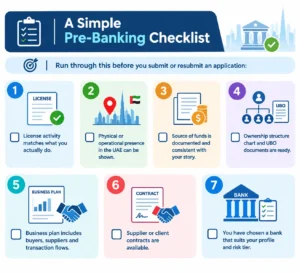
A Simple Pre-Banking Checklist
Run through this before you submit or resubmit an application:
☐ License activity matches what you actually do.
☐ Physical or operational presence in the UAE can be shown.
☐ Source of funds is documented and consistent with your story.
☐ Ownership structure chart and UBO documents are ready.
☐ Business plan includes buyers, suppliers and transaction flows.
☐ Supplier or client contracts are available.
☐ You have chosen a bank that suits your profile and risk tier
How PRO consultancy Can Help
Amana Business Services, business setup consultancy and pro agency in dubai, supports entrepreneurs with company formation, PRO services, licensing and pre-banking file preparation in the UAE. For corporate banking, we help you:
- Review your file against common compliance concerns before you apply.
- Align your license activity, business plan and documents.
- Arrange practical requirements such as Ejari, visas and PRO filings.
Get a Pre-Banking File Review Before You Apply. Speak to an Amana consultant today.
Frequently Asked Questions
Why do UAE banks reject business accounts even when I have a valid trade license?
A trade license proves your company is registered. Banks also assess ownership, source of funds, activity and operational presence, and a gap in any of these can lead to a decline.
Can I reapply after my business bank account is rejected?
Often yes, once you have fixed the underlying weaknesses in your file.
Is a flexi-desk enough for a corporate bank account?
Not always. Many banks want clearer proof of real operations, such as a lease, contracts or local activity.
Does a free zone company face more difficulty?
Banks assess substance, ownership and funds for both free zone and mainland companies. Free zone companies with no UAE presence may face extra questions.
About The Author